bio.wikisort.org - Animal
Coleophora currucipennella is a moth of the family Coleophoridae found in Europe. It was first described by Philipp Christoph Zeller in 1839.
| Coleophora currucipennella | |
|---|---|
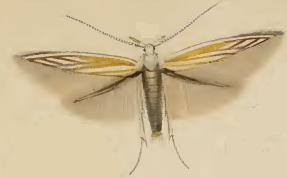 | |
Scientific classification  | |
| Kingdom: | Animalia |
| Phylum: | Arthropoda |
| Class: | Insecta |
| Order: | Lepidoptera |
| Family: | Coleophoridae |
| Genus: | Coleophora |
| Species: | C. currucipennella |
| Binomial name | |
| Coleophora currucipennella Zeller, 1839[1] | |
Description
The larvae feed on birch (Betula species), hornbeam (Carpinus betulus), hazel (Corylus avellana), beech (Fagus sylvatica), apple (Malus species), sour cherry (Prunus cerasus), blackthorn (Prunus spinosa}, common pear (Pyrus communis), sessile oak (Quercus petraea), common oak (Quercus robur), northern red ock (Quercus rubra), willow (Salix species) and rowan (Sorbus aucuparia). Full-grown larva live in a dull black pistol case of about 9 mm and with a mouth angle of 80–90° (meaning it stands erect on the leaf). After hibernation, the larvae no longer mine, but rather cause skeleton feeding.[3] Full-grown larvae can be found in early June.
Distribution
The moth is found in most of Europe, except Ireland, the Iberian Peninsula and the Mediterranean Islands.[4]
References
- "Coleophora currucipennella Zeller, 1839". Fauna Europaea. Retrieved 27 December 2019.
- "microlepidoptera.nl". Archived from the original on 2011-02-12. Retrieved 2011-04-28.
- "bladmineerders.nl". Archived from the original on 2012-04-19. Retrieved 2011-04-28.
- Ellis, W N. "Coleophora currucipennella Zeller, 1839 scarce wood case-bearer". Plant Parasites of Europe. Retrieved 27 December 2019.
External links
 Media related to Coleophora currucipennella at Wikimedia Commons


 | This article on a moth of the family Coleophoridae is a stub. You can help Wikipedia by expanding it. |
Другой контент может иметь иную лицензию. Перед использованием материалов сайта WikiSort.org внимательно изучите правила лицензирования конкретных элементов наполнения сайта.
WikiSort.org - проект по пересортировке и дополнению контента Википедии