bio.wikisort.org - Plant
Schizolaena hystrix is a tree in the family Sarcolaenaceae. It is endemic to Madagascar. The specific epithet hystrix is from the Latin meaning "spiny", referring to the porcupine-like appearance of the involucre.[3]
| Schizolaena hystrix | |
|---|---|
Conservation status | |
Scientific classification  | |
| Kingdom: | Plantae |
| Clade: | Tracheophytes |
| Clade: | Angiosperms |
| Clade: | Eudicots |
| Clade: | Rosids |
| Order: | Malvales |
| Family: | Sarcolaenaceae |
| Genus: | Schizolaena |
| Species: | S. hystrix |
| Binomial name | |
| Schizolaena hystrix | |
Description
Schizolaena hystrix grows as a large tree up to 35 metres (110 ft) tall. Its leaves are coriaceous.[3] The spiny involucre is fleshy and is thought to attract lemurs, bats and birds who in turn disperse the tree's seeds.[1]
Distribution and habitat
Schizolaena hystrix is known only from the northeastern regions of Sava, Alaotra-Mangoro, Analanjirofo and Atsinanana.[2] Its habitat is humid evergreen forests from sea-level to 1,500 m (5,000 ft) altitude.[1]
Threats
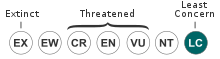
Schizolaena hystrix is threatened by deforestation and by threats to the lemur. Deforestation due to shifting agriculture is occurring outside protected areas. However, 9 of 14 subpopulations of the tree are within protected areas. Threats to lemurs would in turn affect the tree's reproduction due to their role in seed dispersal.[1]
References
- Members of the IUCN SSC Madagascar Plant Specialist Group (2016). "Schizolaena hystrix". IUCN Red List of Threatened Species. 2016: e.T64563494A64574443. doi:10.2305/IUCN.UK.2016-1.RLTS.T64563494A64574443.en. Retrieved 19 November 2021.
- "Schizolaena hystrix". Catalogue of the Vascular Plants of Madagascar. Missouri Botanical Garden. Retrieved 29 Oct 2016 – via Tropicos.org.
- Lowry II, Porter P.; Schatz, George E.; Leroy, Jean-François; Wolf, Anne-Elizabeth (Jan 1999). "Endemic families of Madagascar. III. A synoptic revision of Schizolaena (Sarcolaenaceae)". Adansonia. 3. Paris: Publications Scientifiques du Muséum national d'Histoire naturelle. 21 (2): 198–199. Retrieved 29 Oct 2016.
 | This Sarcolaenaceae-related article is a stub. You can help Wikipedia by expanding it. |
Другой контент может иметь иную лицензию. Перед использованием материалов сайта WikiSort.org внимательно изучите правила лицензирования конкретных элементов наполнения сайта.
WikiSort.org - проект по пересортировке и дополнению контента Википедии