bio.wikisort.org - Animal
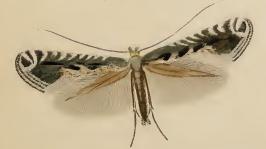
Parornix torquillella is a moth of the family Gracillariidae. It is known from all of Europe, except Spain and parts of the Balkan Peninsula.


| Parornix torquillella | |
|---|---|
 | |
| Scientific classification | |
| Kingdom: | Animalia |
| Phylum: | Arthropoda |
| Class: | Insecta |
| Order: | Lepidoptera |
| Infraorder: | Heteroneura |
| Family: | Gracillariidae |
| Genus: | Parornix |
| Species: | P. torquillella |
| Binomial name | |
| Parornix torquillella (Zeller, 1850)[1] | |
| Synonyms | |
| |
The wingspan is 9–13 mm.[2] The head is pale ochreous mixed with fuscous. Palpi white. Forewings are rather dark fuscous, purplish-tinged, towards dorsum and costa more blackish numerous costal streaks, a spot in disc posteriorly, and two or three dorsal spots white; a black apical dot, strongly white edged anteriorly; cilia with three entire dark fuscous lines. Hind wings are grey. The larva is pale yellow -green; dorsal line dark green or reddish; head pale yellow; segment 2 with four black spots.[3]
The larvae feed on Prunus cerasus, Prunus domestica, Prunus insititia, Prunus maritima and Prunus spinosa. They mine the leaves of their host plant. The mine starts as a lower-surface epidermal gallery that widens into a blotch. In the end, it becomes a small, only weakly inflated tentiform mine. The lower epidermis is whitish, unfolded, and rather transparent. The leaf tissue is eaten up to the upper epidermis. The frass is deposited in a corner of the mine. In the end, the larva leaves the mine and lives freely under a leaf tip or margin that has been folded downwards, or in a leaf that is rolled into a pod.[4]
References
- Fauna Europaea
- microlepidoptera.nl Archived 2012-09-28 at the Wayback Machine
- Meyrick, E., 1895 A Handbook of British Lepidoptera MacMillan, London pdf
 This article incorporates text from this source, which is in the public domain. Keys and description
 - bladmineerders.nl

Другой контент может иметь иную лицензию. Перед использованием материалов сайта WikiSort.org внимательно изучите правила лицензирования конкретных элементов наполнения сайта.
WikiSort.org - проект по пересортировке и дополнению контента Википедии