bio.wikisort.org - Animal
This is a list of dinosaurs whose remains have been recovered from Australia or Antarctica.
Criteria for inclusion
- The creature must appear on the List of dinosaur genera.
- Fossils of the creature must have been found in Australia or Antarctica.
- This list is a complement to Category:Dinosaurs of Australia and Category:Dinosaurs of Antarctica.
List of Australian and Antarctic dinosaurs
Valid genera
| Name | Year | Formation | Location | Notes | Images |
|---|---|---|---|---|---|
| Antarctopelta | 2006 | Snow Hill Island Formation (Late Cretaceous, Campanian) |  Antarctica Antarctica |
Possessed unusual caudal vertebrae that may have supported a "macuahuitl" as in Stegouros[1] | 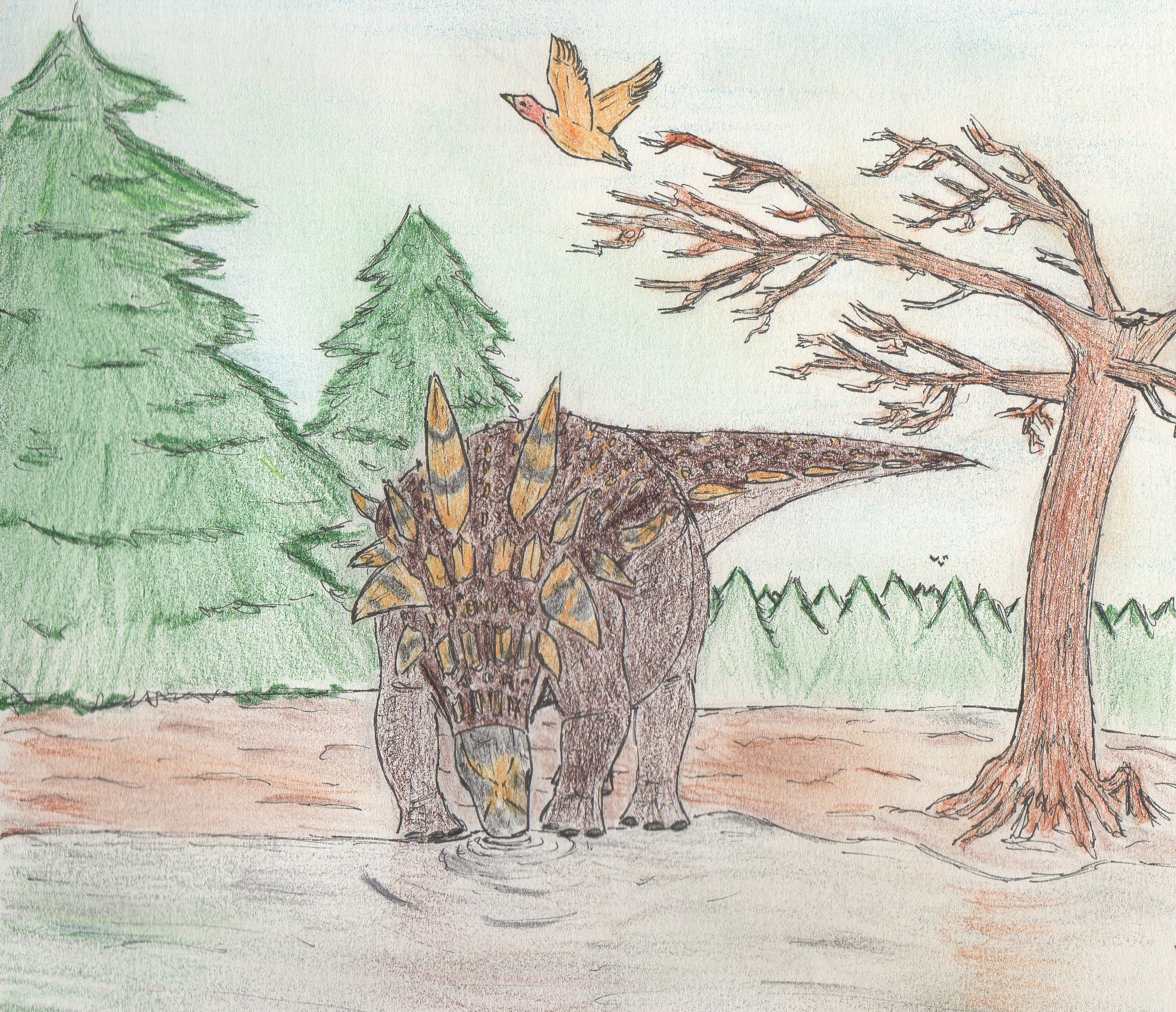 |
| Atlascopcosaurus | 1989 | Eumeralla Formation (Early Cretaceous, Aptian to Albian) |  Australia Australia |
Only known from remains of jaws and teeth |  |
| Australotitan | 2021 | Winton Formation (Late Cretaceous, Cenomanian to Turonian) | Australia |
The largest dinosaur known from Australia, comparable in size to large South American dinosaurs | |
| Australovenator | 2009 | Winton Formation (Early Cretaceous, Albian) | Australia |
Analysis of its arms suggest it was well-adapted to grasping[2] |  |
| Austrosaurus | 1933 | Allaru Formation (Early Cretaceous, Albian) | Australia |
Its holotype was found associated with marine shells |  |
| Cryolophosaurus | 1994 | Hanson Formation (Early Jurassic, Sinemurian to Pliensbachian) | Antarctica |
Had a distinctive "pompadour" crest that spanned the head from side to side |  |
| Diamantinasaurus | 2009 | Winton Formation (Late Cretaceous, Cenomanian) | Australia |
May have been closely related to South American titanosaurs, suggesting they dispersed to Australia via Antarctica[3] |  |
| Diluvicursor | 2018 | Eumeralla Formation (Early Cretaceous, Albian) | Australia |
Lived in a prehistoric floodplain close to a high-energy river |  |
| Fostoria | 2019 | Griman Creek Formation (Late Cretaceous, Cenomanian) | Australia |
Four indidivuals have been found in association | |
| Fulgurotherium | 1932 | Griman Creek Formation (Late Cretaceous, Cenomanian) | Australia |
Fragmentary, but may have been an elasmarian[4] |  |
| Galleonosaurus | 2019 | Wonthaggi Formation (Early Cretaceous, Barremian) | Australia |
Its upper jaw bone resembles a galleon when turned upside-down | |
| Glacialisaurus | 2007 | Hanson Formation (Early Jurassic, Pliensbachian) | Antarctica |
Basal yet survived late enough to coexist with true sauropods[5] |  |
| Imperobator | 2019 | Snow Hill Island Formation (Late Cretaceous, Maastrichtian) | Antarctica |
Unusually for a paravian, it lacked an enlarged sickle claw | |
| Kakuru | 1980 | Bulldog Shale (Early Cretaceous, Aptian) | Australia |
Poorly known | |
| Kunbarrasaurus | 2015 | Allaru Formation (Early Cretaceous to Late Cretaceous, Albian to Cenomanian) | Australia |
Preserves stomach contents containing ferns, fruits, and seeds[6] |  |
| Leaellynasaura | 1989 | Eumeralla Formation (Early Cretaceous, Albian) | Australia |
One referred specimen has an extremely long tail; if it does belong to this genus, it would be three times as long as the rest of the body |  |
| Minmi | 1980 | Bungil Formation (Early Cretaceous, Aptian) | Australia |
Had long legs for an ankylosaur, possibly to help it run into bushes for protection[7] |  |
| Morrosaurus | 2016 | Snow Hill Island Formation (Late Cretaceous, Maastrichtian) | Antarctica |
Closely related to Australian and South American ornithopods[4] | |
| Muttaburrasaurus | 1981 | Allaru Formation?, Mackunda Formation (Early Cretaceous to Late Cretaceous, Albian to Cenomanian) | Australia |
Possessed a short oval bump on its snout |  |
| Ozraptor | 1998 | Colalura Sandstone (Middle Jurassic, Bajocian) | Australia |
Potentially the oldest known abelisauroid[8] | |
| Qantassaurus | 1999 | Wonthaggi Formation (Early Cretaceous, Aptian) | Australia |
Distinguished from its other contemporary ornithopods by its relatively short dentary | |
| Rapator | 1932 | Griman Creek Formation (Early Cretaceous to Late Cretaceous, Albian to Cenomanian) | Australia |
Known from only a metacarpal |  |
| Rhoetosaurus | 1926 | Walloon Coal Measures (Late Jurassic, Oxfordian) | Australia |
Retains four claws on its hind feet, a basal trait | |
| Savannasaurus | 2016 | Winton Formation (Middle Cretaceous, Cenomanian to Turonian) | Australia |
May have spent more time near water than other sauropods[9] | |
| Serendipaceratops | 2003 | Wonthaggi Formation (Early Cretaceous, Aptian) | Australia |
Possessed a robust ulna similar to those of ceratopsians and ankylosaurs | |
| Timimus | 1993 | Eumeralla Formation (Early Cretaceous, Albian) | Australia |
Potentially a tyrannosauroid;[10] if so it would be one of the few Gondwanan members of that group | |
| Trinisaura | 2013 | Snow Hill Island Formation (Late Cretaceous, Campanian) | Antarctica |
The first ornithopod named from Antarctica |  |
| Weewarrasaurus | 2018 | Griman Creek Formation (Late Cretaceous, Cenomanian) | Australia |
Unusually, its fossils were preserved in opal |  |
| Wintonotitan | 2009 | Winton Formation (Late Cretaceous, Cenomanian) | Australia |
More gracile than other contemporary titanosaurs |  |
Dubious, uncertain, and invalid genera
- Agrosaurus macgillivrayi: Although originally reported as being from Australia, it may actually be from Europe, possibly being synonymous with Thecodontosaurus.
- "Allosaurus robustus": Originally described as a new species of Allosaurus, but may actually represent a megaraptoran or abelisauroid.
- "Biscoveosaurus": Said to be a large ornithopod contemporary with Morrosaurus.
- Walgettosuchus woodwardi: It has been considered synonymous with Rapator, but too little is known of both genera to be certain.
Timeline
This is a timeline of selected dinosaurs from the list above. Time is measured in Ma, megaannum, along the x-axis.

See also
- List of birds of Australia
- List of birds of Antarctica
References
- Soto-Acuña, Sergio; Vargas, Alexander O.; Kaluza, Jonatan; Leppe, Marcelo A.; Botelho, Joao F.; Palma-Liberona, José; Simon-Gutstein, Carolina; Fernández, Roy A.; Ortiz, Héctor; Milla, Verónica; Aravena, Bárbara; Manríquez, Leslie M. E.; Alarcón-Muñoz, Jhonatan; Pino, Juan Pablo; Trevisan, Cristine; Mansilla, Héctor; Hinojosa, Luis Felipe; Muñoz-Walther, Vicente; Rubilar-Rogers, David (9 December 2021). "Bizarre tail weaponry in a transitional ankylosaur from subantarctic Chile". Nature. 600 (7888): 259–263. doi:10.1038/s41586-021-04147-1. PMID 34853468. S2CID 244799975.
- White, Matt A.; Bell, Phil R.; Cook, Alex G.; Barnes, David G.; Tischler, Travis R.; Bassam, Brant J.; Elliott, David A. (14 September 2015). "Forearm Range of Motion in Australovenator wintonensis (Theropoda, Megaraptoridae)". PLOS ONE. 10 (9): e0137709. Bibcode:2015PLoSO..1037709W. doi:10.1371/journal.pone.0137709. ISSN 1932-6203. PMC 4569425. PMID 26368529.
- Poropat, Stephen F; Kundrát, Martin; Mannion, Philip D; Upchurch, Paul; Tischler, Travis R; Elliott, David A (20 January 2021). "Second specimen of the Late Cretaceous Australian sauropod dinosaur Diamantinasaurus matildae provides new anatomical information on the skull and neck of early titanosaurs". Zoological Journal of the Linnean Society. 192 (2): 610–674. doi:10.1093/zoolinnean/zlaa173. ISSN 0024-4082.
- Rozadilla, Sebastián; Agnolín, Federico Lisandro; Novas, Fernando Emilio (17 December 2019). "Osteology of the Patagonian ornithopod Talenkauen santacrucensis (Dinosauria, Ornithischia)". Journal of Systematic Palaeontology. 17 (24): 2043–2089. doi:10.1080/14772019.2019.1582562. ISSN 1477-2019. S2CID 155344014.
- Smith, N.D.; Makovicky, P.J.; Pol, D.; Hammer, W.R. & Currie, P.J. (2007). "The Dinosaurs of the Early Jurassic Hanson Formation of the Central Transantarctic Mountains: Phylogenetic Review and Synthesis" (PDF). U.S. Geological Survey and the National Academies. 2007 (1047srp003): 5 pp. doi:10.3133/of2007-1047.srp003.
- Molnar, Ralph E.; Clifford, H. Trevor (2001). "An ankylosaurian cololite from Queensland, Australia". In Carpenter, Kenneth (ed.). The Armored Dinosaurs. Bloomington, IN: Indiana University Press. pp. 399–412. ISBN 0-253-33964-2.
- Paul, Gregory S. (2010). The Princeton Field Guide to Dinosaurs. United States: Princeton University Press. pp. 226–228. ISBN 978-0-691-13720-9.
- Rauhut, O.W.M. (2005). "Post-cranial remains of ‘coelurosaurs’ (Dinosauria, Theropoda) from the Late Jurassic of Tanzania". Geological Magazine 142 (1): 97–107
- Poropat, S.F.; Mannion, P.D.; Upchurch, P.; Tischler, T.R.; Sloan, T.; Sinapius, G.H.K.; Elliott, J.A.; Elliott, D.A. (2020). "Osteology of the Wide-Hipped Titanosaurian Sauropod Dinosaur Savannasaurus elliottorum from the Upper Cretaceous Winton Formation of Queensland, Australia". Journal of Vertebrate Paleontology. 40 (3): e1786836. doi:10.1080/02724634.2020.1786836. S2CID 224850234.
- Rafael Delcourt; Orlando Nelson Grillo (2018). "Tyrannosauroids from the Southern Hemisphere: Implications for biogeography, evolution, and taxonomy". Palaeogeography, Palaeoclimatology, Palaeoecology. in press. doi:10.1016/j.palaeo.2018.09.003.


Lists of dinosaurs by continent | ||
|---|---|---|
| Non-avian dinosaurs |
|  |
| Birds |
| |
Текст в блоке "Читать" взят с сайта "Википедия" и доступен по лицензии Creative Commons Attribution-ShareAlike; в отдельных случаях могут действовать дополнительные условия.
Другой контент может иметь иную лицензию. Перед использованием материалов сайта WikiSort.org внимательно изучите правила лицензирования конкретных элементов наполнения сайта.
Другой контент может иметь иную лицензию. Перед использованием материалов сайта WikiSort.org внимательно изучите правила лицензирования конкретных элементов наполнения сайта.
2019-2026
WikiSort.org - проект по пересортировке и дополнению контента Википедии
WikiSort.org - проект по пересортировке и дополнению контента Википедии