bio.wikisort.org - Plant
Sabatia kennedyana is a species of flowering plant in the gentian family known by the common name Plymouth rose gentian.[3] It is native to eastern North America. It has a disjunct distribution, occurring in Nova Scotia,[4] Massachusetts, Rhode Island, Virginia,[5] North Carolina, and South Carolina.[6]
| Sabatia kennedyana | |
|---|---|
 | |
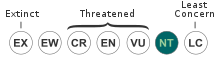
Conservation status | |
Scientific classification  | |
| Kingdom: | Plantae |
| Clade: | Tracheophytes |
| Clade: | Angiosperms |
| Clade: | Eudicots |
| Clade: | Asterids |
| Order: | Gentianales |
| Family: | Gentianaceae |
| Genus: | Sabatia |
| Species: | S. kennedyana |
| Binomial name | |
| Sabatia kennedyana | |

Distribution
Sabatia kennedyana grows in wetlands, particularly lakes and ponds on the Atlantic coastal plain.[7] It grows in areas with fluctuating water levels and other forms of natural disturbance, such as ice scour, which eliminate competing vegetation.[8][9] It is a poor competitor with other plants.[10][5]
Description
Sabatia kennedyana is a perennial herb with stolons tipped with basal rosettes of leaves. The flower is pink with a white or yellow center.[6] It may be 5 centimeters wide, with 9 to 11 petals.[5]
Taxonomy
Sabatia kennedyana is considered by some authors as conspecific with Sabatia dodecandra.[11]
Conservation
Sabatia kennedyana is threatened by shoreline development, recreational activity, off-road vehicles, construction of hydroelectric dams,[6] pollution, and poaching.[5]
References
- Smith, K. 2016. Sabatia kennedyana. The IUCN Red List of Threatened Species 2016: e.T64324190A67730742. https://dx.doi.org/10.2305/IUCN.UK.2016-1.RLTS.T64324190A67730742.en. Accessed on 20 October 2022.
- "NatureServe Explorer 2.0". explorer.natureserve.org. Retrieved 20 October 2022.
- USDA, NRCS (n.d.). "Sabatia kennedyana". The PLANTS Database (plants.usda.gov). Greensboro, North Carolina: National Plant Data Team. Retrieved 26 October 2015.
- SpeciesAtRisk.ca: Sabatia kennedyana in Nova Scotia (coastal plain flora)
- Sabatia kennedyana. Archived 2011-10-26 at the Wayback Machine Center for Plant Conservation.
- Sabatia kennedyana. The Nature Conservancy.
- Sorrie, B. A. 1994. Coastal plain ponds in New England. Biological Conservation 68: 225–233.
- Keddy, P.A. and I. C. Wisheu. 1989. Ecology, biogeography and conservation of coastal plain plants: some general principles from the study of Nova Scotia wetlands. Rhodora 91: 72-94.
- Hill, N. and P.A. Keddy. 1992. Predicting numbers of rarities from habitat variables: coastal plain plants of Nova Scotian lakeshores. Ecology 73: 1852-1859.
- Wisheu, I. C. and P.A. Keddy. 1994. The low competitive ability of Canada's Atlantic coastal plain shoreline flora: implications for conservation. Biological Conservation 68: 247-252.
- Go Botany: Sabatia kennedyana
External links
Другой контент может иметь иную лицензию. Перед использованием материалов сайта WikiSort.org внимательно изучите правила лицензирования конкретных элементов наполнения сайта.
WikiSort.org - проект по пересортировке и дополнению контента Википедии