bio.wikisort.org - Plant
Quercus acuta, the Japanese evergreen oak, is an oak native to Japan, South Korea, Taiwan, and China's Guizhou Province and Guangdong Province.[3]
| Japanese evergreen oak | |
|---|---|
 | |
 | |
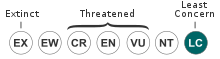
Conservation status | |
Scientific classification  | |
| Kingdom: | Plantae |
| Clade: | Tracheophytes |
| Clade: | Angiosperms |
| Clade: | Eudicots |
| Clade: | Rosids |
| Order: | Fagales |
| Family: | Fagaceae |
| Genus: | Quercus |
| Subgenus: | Quercus subg. Cyclobalanopsis |
| Species: | Q. acuta |
| Binomial name | |
| Quercus acuta | |
| Synonyms[2] | |
|
List
| |
Description
Due to its foliage and habitat, it looks rather unlike most other oaks. Quercus acuta is usually bushy and densely domed, reaching a height of 14 meters. The bark is smooth and dark grey. Leaves are dark and glossy above and yellowish beneath. They narrow to a long, finely-rounded tip. The flowers are on a stiff 5 cm catkin.
Heartwood is pale reddish brown to reddish brown. Sapwood is pale yellowish brown with a slightly reddish color.[4]
Common names
In Japan, it is called akagashi (赤樫 - あかがし), but is also known by the names oogashi (大樫 - オオガシ) and oobagashi (大葉樫 - オオバガシ).[5] [6]
In the Korean language, it is 붉가시.
Uses
Like shirakashi (白樫 - しらかし) (Quercus myrsinifolia), whose wood is often called shirokashi outside of Japan, and other related sub-genera, Japanese Evergreen Oak, or akagashi, is a preferred choice for Japanese martial arts practice weapons such as bokken.[7][8] This is due to its uniformly tight grain structure resulting from its continuous growing season. It should not be confused with the oriental or Asian white oak, Quercus aliena.
References
- Botanic Gardens Conservation International (BGCI) & IUCN SSC Global Tree Specialist Group (2018). "Quercus acuta". The IUCN Red List of Threatened Species. IUCN. 208. e.T62005627A13677623. doi:10.2305/IUCN.UK.2019-1.RLTS.T62005627A136776235.en.
- The Plant List, Quercus acuta Thunb.
- "Quercus acuta"Oaks of the World Accessed 8 April 2011.
- 木材図鑑 - Picture Book of Woods Accessed 22 March 2017. (in Japanese)
- TSUYUZAKI Shiro's Plant List - Hokkaido University
- 植物和名ー学名インデックス YList - The YList Botanical Name - Scientific Name Index Accessed 22 March 2017. (in Japanese)
- Zaimoku - Wood for Weapons Accessed 22 March 2017.
- James Goedkoop: "Woods for Training Weapons". Aikiweb Accessed 10 November 2012.
 | This article about plants in the genus Quercus is a stub. You can help Wikipedia by expanding it. |
На других языках
- [en] Quercus acuta
[es] Quercus acuta
Quercus acuta, la encina japonesa[2] o roble siempreverde japonés[3] es un árbol perennifolio que mide entre 10 y 20 metros de altura,[1] aunque puede llegar a los 25 m de altura. Su copa es densa de unos 5 metros de diámetro y de silueta ovalada o redondeada con ramas bajas y de corteza liza de color gris, a menudo con múltiples troncos.[4]Другой контент может иметь иную лицензию. Перед использованием материалов сайта WikiSort.org внимательно изучите правила лицензирования конкретных элементов наполнения сайта.
WikiSort.org - проект по пересортировке и дополнению контента Википедии