bio.wikisort.org - Plant
Ponerorchis secundiflora (synonym Neottianthe secundiflora) is a species of plant in the family Orchidaceae. It is native from the Himalayas to China.[1]
| Ponerorchis secundiflora | |
|---|---|
 | |
Conservation status | |
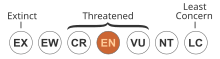 Endangered (IUCN 3.1) | |
Scientific classification  | |
| Kingdom: | Plantae |
| Clade: | Tracheophytes |
| Clade: | Angiosperms |
| Clade: | Monocots |
| Order: | Asparagales |
| Family: | Orchidaceae |
| Subfamily: | Orchidoideae |
| Genus: | Ponerorchis |
| Species: | P. secundiflora |
| Binomial name | |
| Ponerorchis secundiflora (Kraenzl.) X.H.Jin, Schuit. & W.T.Jin | |
| Synonyms[1] | |
| |
Taxonomy
The species was described by Joseph Dalton Hooker in 1890, under the name "Habenaria secundiflora".[1] However, this name had already been used for a different species in 1881, so was illegitimate.[2] The species was first legitimately named in 1898 by Friedrich Kraenzlin as Peristylus secundiflorus. It was later transferred to Gymnadenia and then to Neottianthe.[1] A molecular phylogenetic study in 2014 found that species of Neottianthe, Amitostigma and Ponerorchis were mixed together in a single clade, making none of the three genera monophyletic as then circumscribed. Neottianthe and Amitostigma were subsumed into Ponerorchis, with this species becoming Ponerorchis secundiflora.[3]
Distribution
Ponerorchis secundiflora is native to the Himalayas, including Tibet, Nepal and the Assam region. Its range extends to Myanmar and south-central China (west Sichuan and north-west Yunnan).[1]
References
- "Ponerorchis secundiflora", World Checklist of Selected Plant Families, Royal Botanic Gardens, Kew, retrieved 2018-03-17
- "Plant Name Details for Habenaria secundiflora", The International Plant Names Index, retrieved 2018-03-31
- Jin, Wei-Tao; Jin, Xiao-Hua; Schuiteman, André; Li, De-Zhu; Xiang, Xiao-Guo; Huang, Wei-Chang; Li, Jian-Wu & Huang, Lu-Qi (2014), "Molecular systematics of subtribe Orchidinae and Asian taxa of Habenariinae (Orchideae, Orchidaceae) based on plastid matK, rbcL and nuclear ITS", Molecular Phylogenetics and Evolution, 77: 41–53, doi:10.1016/j.ympev.2014.04.004, PMID 24747003
 | This Orchidoideae-related article is a stub. You can help Wikipedia by expanding it. |
Другой контент может иметь иную лицензию. Перед использованием материалов сайта WikiSort.org внимательно изучите правила лицензирования конкретных элементов наполнения сайта.
WikiSort.org - проект по пересортировке и дополнению контента Википедии