bio.wikisort.org - Plant
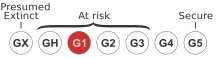
Polyscias flynnii (known by the common names Flynn's ʻOhe[4] and ʻOheʻohe) is a plant species endemic to the island of Kauai in Hawaii. It is rare, found only in one population covering about 1 km2 in the Kalalau Valley. It is regarded as threatened.[5] It is threatened by feral goats and non-native plant species in its habitat. It was federally listed as an endangered species of the United States in 2010.[1]
| Polyscias flynnii | |
|---|---|
 | |
Conservation status | |
Scientific classification  | |
| Kingdom: | Plantae |
| Clade: | Tracheophytes |
| Clade: | Angiosperms |
| Clade: | Eudicots |
| Clade: | Asterids |
| Order: | Apiales |
| Family: | Araliaceae |
| Genus: | Polyscias |
| Species: | P. flynnii |
| Binomial name | |
| Polyscias flynnii (Lowry & K.R. Wood) Lowry & G. M. Plunkett | |
| Synonyms[2][3] | |
|
Tetraplasandra flynnii Lowry & K.R. Wood | |
This plant was first discovered in 1988 and described to science as a new species in 2000.[6] There are only five individuals known to exist.[7]
Polyscias flynnii is a tree up to 9 m tall. Leaves are pinnately compound, up to 60 cm long, with reddish-brown hairs on the underside but not on the upper side. Inflorescence is a panicle or umbel hanging from the axils of the leaves, with 10-15 flowers. Flowers are yellow-green, some hermaphroditic (both male and female) but others on the same plant staminate (male only).[6][8]
References
- Tetraplasandra flynnii. The Nature Conservancy.
- Tropicos
- The Plant List
- USDA, NRCS (n.d.). "Tetraplasandra flynii". The PLANTS Database (plants.usda.gov). Greensboro, North Carolina: National Plant Data Team. Retrieved 9 December 2015.
- Lowry, P.P., & G.M. Plunkett. 2010. Plant Diversity and Evolution 128: 74.
- Lowry, P. P. and K. R. Wood. (2000). A new, threatened species of Tetraplasandra (Araliaceae) from Kauai, Hawaiian Islands, and notes on its conservation status. Novon 10(1) 40-44.
- USFWS. Determination of Endangered Status for 48 Species on Kauai and Designation of Critical Habitat; Final Rule. Federal Register April 13, 2010.
- photo of isotype at Missouri Botanical Garden
Другой контент может иметь иную лицензию. Перед использованием материалов сайта WikiSort.org внимательно изучите правила лицензирования конкретных элементов наполнения сайта.
WikiSort.org - проект по пересортировке и дополнению контента Википедии