bio.wikisort.org - Plant
Paeonia parnassica, the Greek peony, is a plant that is native to the mountains of south-central Greece. The flowers are produced in late spring with a deep maroon red colouring on 65 cm stems. The blooms are large, up to 12 cm in diameter and bear a boss of rich orange stamens. This peony was once included with the species P. mascula.[2]
| Paeonia parnassica | |
|---|---|
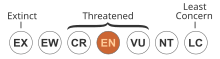
Conservation status | |
Scientific classification  | |
| Kingdom: | Plantae |
| Clade: | Tracheophytes |
| Clade: | Angiosperms |
| Clade: | Eudicots |
| Order: | Saxifragales |
| Family: | Paeoniaceae |
| Genus: | Paeonia |
| Species: | P. parnassica |
| Binomial name | |
| Paeonia parnassica Tzanoud. | |
Genetics
The Greek peony is an autotetraploid (4n=20) of which the diploid parent must have gone extinct.[3]
References
- Bazos, I.; Delipetrou, P. (2011). "Paeonia parnassica". IUCN Red List of Threatened Species. 2011: e.T162095A5535177. doi:10.2305/IUCN.UK.2011-1.RLTS.T162095A5535177.en. Retrieved 20 November 2021.
- Peonies: The Imperial Flower by Jane Fearnley-Whittingstall ISBN 0-297-82424-4
- Ferguson, Diane; Sang, Tao (2001). "Speciation through homoploid hybridization between allotetraploids in peonies (Paeonia)" (PDF). Proceedings of the National Academy of Sciences of the United States of America. 98 (7): 3915–3919. Bibcode:2001PNAS...98.3915F. doi:10.1073/pnas.061288698. PMC 31153. PMID 11259655. Retrieved 2016-04-30.
 | This Saxifragales-related article is a stub. You can help Wikipedia by expanding it. |
Текст в блоке "Читать" взят с сайта "Википедия" и доступен по лицензии Creative Commons Attribution-ShareAlike; в отдельных случаях могут действовать дополнительные условия.
Другой контент может иметь иную лицензию. Перед использованием материалов сайта WikiSort.org внимательно изучите правила лицензирования конкретных элементов наполнения сайта.
Другой контент может иметь иную лицензию. Перед использованием материалов сайта WikiSort.org внимательно изучите правила лицензирования конкретных элементов наполнения сайта.
2019-2026
WikiSort.org - проект по пересортировке и дополнению контента Википедии
WikiSort.org - проект по пересортировке и дополнению контента Википедии