bio.wikisort.org - Plant
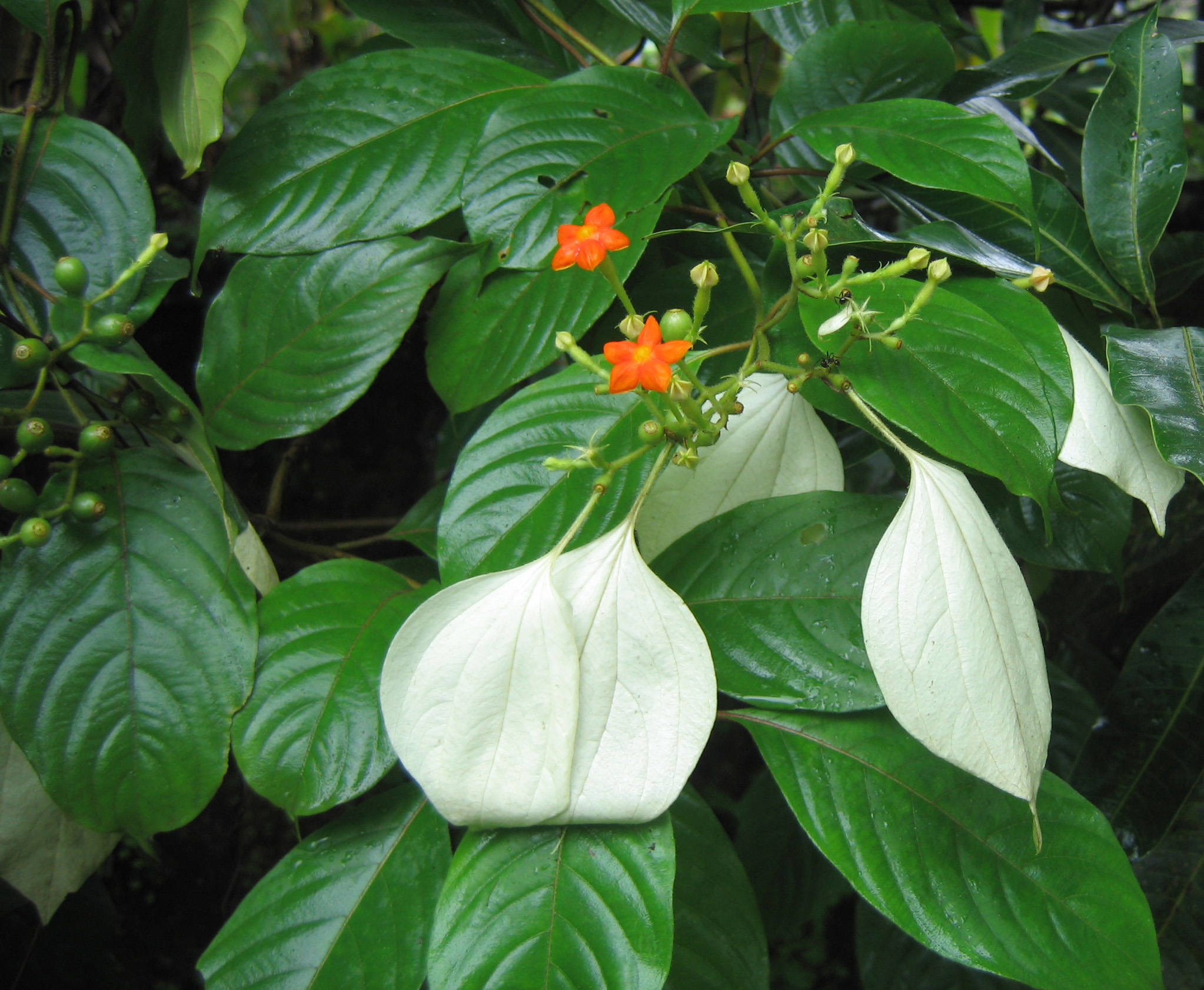
Mussaenda frondosa, commonly known as the wild mussaenda or dhobi tree, is a plant of family Rubiaceae. It is a shrub that grows to about 1.5–2 m (4 ft 11 in – 6 ft 7 in) tall. Like most other Mussaenda species, they have a bract beneath their flowers, which in this species is white in colour.[2]
| Mussaenda frondosa | |
|---|---|
 | |
Scientific classification  | |
| Kingdom: | Plantae |
| Clade: | Tracheophytes |
| Clade: | Angiosperms |
| Clade: | Eudicots |
| Clade: | Asterids |
| Order: | Gentianales |
| Family: | Rubiaceae |
| Genus: | Mussaenda |
| Species: | M. frondosa |
| Binomial name | |
| Mussaenda frondosa | |
| Synonyms[1] | |
| |
Description
The shrub may also grow as a scandent climber. The flowers are clusters of orange-yellow tubular flowers with one of their five sepals enlarged into a white petal-like form, set among pale green, oval leaves; berries follow the bloom. The erect, branching stem has a shrubby crown.
Distribution
Mussaenda frondosa is native to India, Nepal, Sri Lanka, Cambodia, Vietnam, Malaysia and Indonesia.

References
- "The Plant List: A Working List of All Plant Species". Retrieved 23 January 2015.
- Jayaweera, Don M. A. (1963). "The Rubiaceous Genus Mussaenda: The Morphology of the Asiatic Species". Journal of the Arnold Arboretum. 44 (1): 111–126. ISSN 0004-2625. JSTOR 43781456.
External links
Текст в блоке "Читать" взят с сайта "Википедия" и доступен по лицензии Creative Commons Attribution-ShareAlike; в отдельных случаях могут действовать дополнительные условия.
Другой контент может иметь иную лицензию. Перед использованием материалов сайта WikiSort.org внимательно изучите правила лицензирования конкретных элементов наполнения сайта.
Другой контент может иметь иную лицензию. Перед использованием материалов сайта WikiSort.org внимательно изучите правила лицензирования конкретных элементов наполнения сайта.
2019-2026
WikiSort.org - проект по пересортировке и дополнению контента Википедии
WikiSort.org - проект по пересортировке и дополнению контента Википедии