bio.wikisort.org - Plant
Mediusella bernieri is a plant in the family Sarcolaenaceae. It is endemic to Madagascar.
| Mediusella bernieri | |
|---|---|
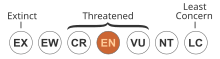
Conservation status | |
Scientific classification  | |
| Kingdom: | Plantae |
| Clade: | Tracheophytes |
| Clade: | Angiosperms |
| Clade: | Eudicots |
| Clade: | Rosids |
| Order: | Malvales |
| Family: | Sarcolaenaceae |
| Genus: | Mediusella |
| Species: | M. bernieri |
| Binomial name | |
| Mediusella bernieri | |
| Synonyms[2] | |
| |
Description
Mediusella bernieri grows as a shrub or small tree up to 3 metres (10 ft) tall.[1] It has a trunk diameter of up to 20 cm (8 in). Its bright green leaves are ovate in shape and measure up to 6 cm (2 in) long. The plant's flowers are usually in inflorescences of two or three flowers, each with white to yellow petals. The ovoid fruits measure up to 1.1 cm (0.4 in) long.[3] Mediusella bernieri flowers and fruits from February to July.[1]
Distribution and habitat
Mediusella bernieri is only found in the far northern regions of Diana and Sava[2] (the former Antsiranana Province[1]). IUCN assessors identified nine subpopulations over an extent of occurrence of 3,055 square kilometres (1,200 sq mi).[1] Its habitat is dry forests, on various rocky formations, from 50–300 m (200–1,000 ft) altitude.[1][3]
Threats
Mediusella bernieri is in decline due to habitat destruction[1][3] from activities such as agriculture, mining, fires and wood harvesting.[1] In 2019, it was assessed by the IUCN as Endangered. Although four (of nine) subpopulations of the species are within the protected areas of Andavakoeira-Andrafiamena and Loky Manambato, the species' decline continues due to the above activities.[1]
References
- Rabarimanarivo, M. (2021). "Mediusella bernieri". IUCN Red List of Threatened Species. 2021: e.T70102206A194109415. doi:10.2305/IUCN.UK.2021-1.RLTS.T70102206A194109415.en. Retrieved 20 November 2021.
- "Mediusella bernieri". Catalogue of the Vascular Plants of Madagascar. Missouri Botanical Garden. Retrieved 19 Oct 2016 – via Tropicos.org.
- Hong-Wa, Cynthia (2009). "Endemic families of Madagascar. XII. Resurrection and taxonomic revision of the genera Mediusella (Cavaco) Hutchinson and Xerochlamys Baker (Sarcolaenaceae)" (PDF). Adansonia. 3. Paris: Publications Scientifiques du Muséum national d'Histoire naturelle. 31 (2): 318–319. doi:10.5252/a2009n2a7. S2CID 84912526. Retrieved 19 Oct 2016.
Другой контент может иметь иную лицензию. Перед использованием материалов сайта WikiSort.org внимательно изучите правила лицензирования конкретных элементов наполнения сайта.
WikiSort.org - проект по пересортировке и дополнению контента Википедии