bio.wikisort.org - Plant
Helicia petiolaris is a plant in the family Proteaceae. The specific epithet petiolaris means "stalked", referring to the leaves.[3]
| Helicia petiolaris | |
|---|---|
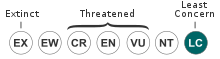
Conservation status | |
Scientific classification  | |
| Kingdom: | Plantae |
| Clade: | Tracheophytes |
| Clade: | Angiosperms |
| Clade: | Eudicots |
| Order: | Proteales |
| Family: | Proteaceae |
| Genus: | Helicia |
| Species: | H. petiolaris |
| Binomial name | |
| Helicia petiolaris | |
Description
Helicia petiolaris grows as a small tree up to 15 metres (50 ft) tall, with a trunk diameter of up to 20 cm (8 in). Its bark is grey-brown. The fruit is black to dark brown, up to 4 cm (2 in) long.[3]
Distribution and habitat
Helicia petiolaris is native to Myanmar, Thailand, Vietnam, Peninsular Malaysia, Singapore and Borneo. Its habitat is mixed dipterocarp and kerangas forests to 2,100 m (7,000 ft) altitude.[1]
References
- Martínez Richart, A.I. (2020). "Helicia petiolaris". IUCN Red List of Threatened Species. 2020: e.T113134238A113310095. doi:10.2305/IUCN.UK.2020-1.RLTS.T113134238A113310095.en. Retrieved 19 November 2021.
- "Helicia petiolaris". Plants of the World Online. Royal Botanic Gardens, Kew. Retrieved 14 September 2020.
- Chung, Richard C. K. (April 2002). "Helicia petiolaris Benn.". In Soepadmo, E.; Saw, L. G.; Chung, R. C. K. (eds.). Tree Flora of Sabah and Sarawak. (free online from the publisher, lesser resolution scan PDF versions). Vol. 4. Forest Research Institute Malaysia. pp. 180–182. ISBN 983-2181-27-5. Archived from the original (PDF) on 27 September 2013. Retrieved 23 September 2013.
 | This Proteaceae-related article is a stub. You can help Wikipedia by expanding it. |
Текст в блоке "Читать" взят с сайта "Википедия" и доступен по лицензии Creative Commons Attribution-ShareAlike; в отдельных случаях могут действовать дополнительные условия.
Другой контент может иметь иную лицензию. Перед использованием материалов сайта WikiSort.org внимательно изучите правила лицензирования конкретных элементов наполнения сайта.
Другой контент может иметь иную лицензию. Перед использованием материалов сайта WikiSort.org внимательно изучите правила лицензирования конкретных элементов наполнения сайта.
2019-2026
WikiSort.org - проект по пересортировке и дополнению контента Википедии
WikiSort.org - проект по пересортировке и дополнению контента Википедии