bio.wikisort.org - Plant
Haloxylon persicum, the white saxaul, is a small tree belonging to the family Amaranthaceae.[2][3] Its range is Western Asia, including the Palestine region, Egypt, Sinai, South Iraq, Saudi Arabia, Iran, Oman, UAE, Afghanistan, and Pakistan, to Central Asia (Kyrgyzstan, Turkmenistan, etc.), and China (Xinjiang etc.).
| Haloxylon persicum | |
|---|---|
 | |
| Haloxylon persicum in Unaizah | |
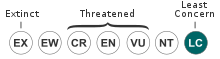
Conservation status | |
Scientific classification  | |
| Kingdom: | Plantae |
| Clade: | Tracheophytes |
| Clade: | Angiosperms |
| Clade: | Eudicots |
| Order: | Caryophyllales |
| Family: | Amaranthaceae |
| Genus: | Haloxylon |
| Species: | H. persicum |
| Binomial name | |
| Haloxylon persicum | |
Description
The Haloxylon persicum has a stout rugged stem and light grey bark, growing up to 4.5–5 metres in height. It lacks large foliage-type leaves; in fact, its leaves have retrogressed as succulent branches. The plant is found in sandhills, deserts and sand ridges, where it often forms pure stands, with an average density up to 400-500 trees a hectare. The white saxaul is a hardy tree that can grow in nutritionally poor soil and can tolerate drought. The tree is in leaf all year, and flowers in May–June.
Uses
The plant's extensive root system is useful for stabilising sandy soils. The wood is durable and heavy and is used in general carpentry. As it burns well and gives a good heat it is used as a fuel. It is called "ghada" in Arabic and was frequently mentioned in classical Arabic poetry.
Pests
Turcmenigena varentzovi (saxaul longhorn beetle, Varentsov's longhorn beetle) is a pest of the white saxaul tree in Kazakhstan, Turkmenistan, and Uzbekistan.


References
- Oldfield, S. (2020). "Haloxylon persicum". IUCN Red List of Threatened Species. 2020: e.T19149376A165379866. doi:10.2305/IUCN.UK.2020-2.RLTS.T19149376A165379866.en. Retrieved 29 October 2022.
- "Haloxylon persicum Bunge". Plants of the World Online. The Trustees of the Royal Botanic Gardens, Kew. n.d. Retrieved October 29, 2022.
- "Haloxylon persicum Bunge". Catalogue of Life. Species 2000. n.d. Retrieved October 29, 2022.
 | This Amaranthaceae article is a stub. You can help Wikipedia by expanding it. |
На других языках
- [en] Haloxylon persicum
[ru] Саксаул белый
Саксаул белый, или песчаный (лат. Haloxylon persicum) — кустарник, распространённый преимущественно в Передней (в том числе на территории Израиля, Египта, Синайского полуострова, южной части Ирака, Саудовской Аравии, Ирана, Омана, ОАЭ, Афганистана), Центральной (Киргизии, Туркмении и т. д.), Южной (в Пакистане) и Восточной Азии (в Синьцзян-Уйгурском автономном округе, входящем в состав Китая). Принадлежит к семейству Амарантовых.Другой контент может иметь иную лицензию. Перед использованием материалов сайта WikiSort.org внимательно изучите правила лицензирования конкретных элементов наполнения сайта.
WikiSort.org - проект по пересортировке и дополнению контента Википедии