bio.wikisort.org - Plant
Dudleya cymosa is a species complex of evergreen and deciduous succulent plants in the family Crassulaceae known by the common name: canyon liveforever.[1][2] It is a loosely defined polyphyletic[3] species with a diverse number of subspecies, varying highly in morphology, distribution, and habitat.[4]
| Dudleya cymosa | |
|---|---|
 | |
| The neotype for D. cymosa, an illustration by John Gilbert Baker | |
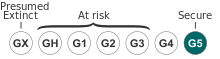
Conservation status | |
Scientific classification  | |
| Kingdom: | Plantae |
| Clade: | Tracheophytes |
| Clade: | Angiosperms |
| Clade: | Eudicots |
| Order: | Saxifragales |
| Family: | Crassulaceae |
| Genus: | Dudleya |
| Species: | D. cymosa |
| Binomial name | |
| Dudleya cymosa | |
| Synonyms | |
|
Echeveria cymosa | |
Description
It is a distinctive plant sending up erect red-orange stems from a gray-green basal rosette. The small yellowish-red thimble-shaped flowers top the stems in a cyme inflorescence. Some subspecies are considered threatened locally.
Subspecies
Recognized[5] Dudleya cymosa subspecies:
- Dudleya cymosa subsp. agourensis K.M. Nakai - (Agoura Hills dudleya)
- Dudleya cymosa subsp. crebrifolia K.M. Nakai & Verity - (San Gabriel River dudleya)
- Dudleya cymosa subsp. costatifolia Bartel & Shevock - (Pierpoint springs dudleya)
- Dudleya cymosa subsp. cymosa (Lem.) Britton & Rose - (canyon liveforever)
- Dudleya cymosa subsp. marcescens Moran - (Marcescent dudleya)
- Dudleya cymosa. subsp. ovatifolia - (Santa Monica Mountains dudleya)
- Dudleya cymosa subsp. paniculata (Jeps.) K.M. Nakai - (Diablo range dudleya)
- Dudleya cymosa subsp. pumila (Rose) K.M. Nakai - (Transverse ranges liveforever)
The subspecies marcescens[6] and ovatifolia[7] are federally listed as threatened species of the United States.
Butterfly habitat
Dudleya cymosa is the larval host plant for the Sonoran blue butterfly, Philotes sonorensis (Lycaenidae)

Notes
- New N. Amer. Crassul. 21. 1903 Sep
- Bull. New York Bot. Gard. 3:21. 1903 Nov
- Yost, J. M.; Bontrager, M.; McCabe, S. W.; Burton, D.; Simpson, M. G.; Kay, K. M.; Ritter, M. (2013). "Phylogenetic relationships and evolution in Dudleya (Crassulaceae)" (PDF). Systematic Botany. 38 (4): 1096–1104. doi:10.1600/036364413X674760. S2CID 15715233.
- McCabe, Stephen Ward (26 September 2019). "Succulent Poaching, Conservation,and the Mainland Dudleyas". Youtube. CNPS Santa Clara Valley Chapter. Archived from the original on 2021-12-21.
- "Dudleya cymosa". Global Biodiversity Information Facility.
{{cite web}}: CS1 maint: url-status (link) - USFWS. ssp. marcescens. Species Profile.
- USFWS. ssp. ovatifolia. Species Profile.
References
- Thomson, Paul H. (1993). Dudleya and Hasseanthus handbook. Bonsall, CA: Bonsall Publication. ISBN 978-0-9602066-5-0.
- C.Michael Hogan, ed. 2010. Dudleya cymosa. Encyclopedia of Life.
External links

 | This Crassulaceae-related article is a stub. You can help Wikipedia by expanding it. |
На других языках
- [en] Dudleya cymosa
[es] Dudleya cymosa
Dudleya cymosa, es una especie de planta suculenta perteneciente a la familia de las crasuláceas.Другой контент может иметь иную лицензию. Перед использованием материалов сайта WikiSort.org внимательно изучите правила лицензирования конкретных элементов наполнения сайта.
WikiSort.org - проект по пересортировке и дополнению контента Википедии