bio.wikisort.org - Plant
Combretum molle, the velvet bushwillow, is a medium to large tree species in the genus Combretum found in western, eastern and southern Africa.
| Velvet bushwillow | |
|---|---|
 | |
| habit, winter | |
Scientific classification  | |
| Kingdom: | Plantae |
| Clade: | Tracheophytes |
| Clade: | Angiosperms |
| Clade: | Eudicots |
| Clade: | Rosids |
| Order: | Myrtales |
| Family: | Combretaceae |
| Genus: | Combretum |
| Species: | C. molle |
| Binomial name | |
| Combretum molle | |
The larvae of Parosmodes morantii and Acalyptris molleivora feed on C. molle. It is recorded to contain antioxidants such as punicalagin,[1] which is also found in the other Myrtale pomegranates (Punica granatum), a somewhat related plant. It also contains the 1alpha-hydroxycycloartenoid saponins mollic acid glucoside[2] and mollic acid 3β-D-xyloside.[3]
Extracts from the bark of C. molle show antibacterial and antifungal[4] as well as in vitro antiprotozoal activities.[1] Mollic acid glucoside shows cardiovascular effects.[2]
 new flush
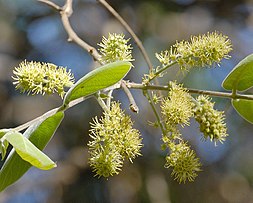 spring foliage and inflorescences
 winter foliage and fruit


See also
References
- Asres, K.; Bucar, F.; Knauder, E.; Yardley, V.; Kendrick, H.; Croft, S. L. (2001). "In vitro antiprotozoal activity of extract and compounds from the stem bark of Combretum molle". Phytotherapy Research. 15 (7): 613–617. doi:10.1002/ptr.897. PMID 11746844. S2CID 24511496.
- Ojewole, J. A. (2008). "Cardiovascular effects of mollic acid glucoside, a 1alpha-hydroxycycloartenoid saponin extractive from Combretum molle R Br ex G Don (Combretaceae) leaf". Cardiovascular Journal of Africa. 19 (3): 128–134. PMC 3974560. PMID 18568171.
- Pegel, K. H.; Rogers, C. B. (1985). "The characterisation of mollic acid 3?-D-xyloside and its genuine aglycone mollic acid, two novel 1?-hydroxycycloartenoids from combretum molle". Journal of the Chemical Society, Perkin Transactions 1: 1711. doi:10.1039/P19850001711.
- Asres, K.; Mazumder, A.; Bucar, F. (2006). "Antibacterial and antifungal activities of extracts of combretum molle". Ethiopian Medical Journal. 44 (3): 269–277. PMID 17447394.
External links
 Data related to Combretum molle at Wikispecies
- Combretum molle in West African plants – A Photo Guide.


Wikimedia Commons has media related to Combretum molle.
 | This Myrtales article is a stub. You can help Wikipedia by expanding it. |
На других языках
- [en] Combretum molle
[ru] Комбретум бархатнолистный
Комбре́тум бархатноли́стный, или мса́на (лат. Combretum molle) — вид вечнозелёных и листопадных растений семейства Комбретовые (Combretaceae).Текст в блоке "Читать" взят с сайта "Википедия" и доступен по лицензии Creative Commons Attribution-ShareAlike; в отдельных случаях могут действовать дополнительные условия.
Другой контент может иметь иную лицензию. Перед использованием материалов сайта WikiSort.org внимательно изучите правила лицензирования конкретных элементов наполнения сайта.
Другой контент может иметь иную лицензию. Перед использованием материалов сайта WikiSort.org внимательно изучите правила лицензирования конкретных элементов наполнения сайта.
2019-2026
WikiSort.org - проект по пересортировке и дополнению контента Википедии
WikiSort.org - проект по пересортировке и дополнению контента Википедии