bio.wikisort.org - Plant
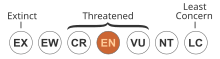
Carex toreadora is a little-known species of sedge from Ecuador. It was described in 1964 by the prolific plant collector Julian A. Steyermark,[2] having been collected in 1943 at an altitude of 3,785–3,900 metres (12,418–12,795 ft) in Azuay Province.[3] There it grew in "moist mossy boggy places bordering [an] alpine lake".[3] No further collections have ever been made, and the species is listed as endangered on the IUCN Red List.[1] It is classified in Carex sect. Ovales, and is thought to be closely related to species such as Carex mandoniana and Carex macloviana.[3]
| Carex toreadora | |
|---|---|
Conservation status | |
Scientific classification  | |
| Kingdom: | Plantae |
| Clade: | Tracheophytes |
| Clade: | Angiosperms |
| Clade: | Monocots |
| Clade: | Commelinids |
| Order: | Poales |
| Family: | Cyperaceae |
| Genus: | Carex |
| Subgenus: | Carex subg. Vignea |
| Section: | Carex sect. Ovales |
| Species: | C. toreadora |
| Binomial name | |
| Carex toreadora Steyerm. | |
References
- Pitman, N. (2004). "Carex toreadora". IUCN Red List of Threatened Species. 2004: e.T45151A10983610. doi:10.2305/IUCN.UK.2004.RLTS.T45151A10983610.en. Retrieved 15 November 2021.
- Mary Susan Taylor (1989). "Plant taxa described by Julian A. Steyermark". Annals of the Missouri Botanical Garden. 76 (3): 652–780. doi:10.2307/2399648. JSTOR 2399648.
- Julian A. Steyermark (1964). "Notes on Ecuador plants". Phytologia. 9 (6): 337–350.
Текст в блоке "Читать" взят с сайта "Википедия" и доступен по лицензии Creative Commons Attribution-ShareAlike; в отдельных случаях могут действовать дополнительные условия.
Другой контент может иметь иную лицензию. Перед использованием материалов сайта WikiSort.org внимательно изучите правила лицензирования конкретных элементов наполнения сайта.
Другой контент может иметь иную лицензию. Перед использованием материалов сайта WikiSort.org внимательно изучите правила лицензирования конкретных элементов наполнения сайта.
2019-2026
WikiSort.org - проект по пересортировке и дополнению контента Википедии
WikiSort.org - проект по пересортировке и дополнению контента Википедии