
 seedpods
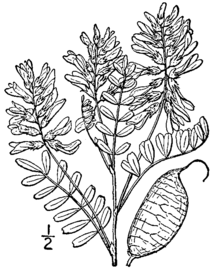 botanical illustration
bio.wikisort.org - Plant
Astragalus neglectus, or Cooper's milkvetch, is a species of flowering plant in the family Fabaceae native to northeastern North America.
| Astragalus neglectus | |
|---|---|
 | |
Conservation status | |
Scientific classification  | |
| Kingdom: | Plantae |
| Clade: | Tracheophytes |
| Clade: | Angiosperms |
| Clade: | Eudicots |
| Clade: | Rosids |
| Order: | Fabales |
| Family: | Fabaceae |
| Subfamily: | Faboideae |
| Genus: | Astragalus |
| Species: | A. neglectus |
| Binomial name | |
| Astragalus neglectus (Torr. & A.Gray) E. Sheld. | |
| Synonyms | |
| |
Description
Astragalus neglectus is a perennial, herbaceous plant growing 30 to 90 cm tall.[2] The alternate, compound leaves have 11-25 leaflets.[3] The 10 to 20 white or creamy flowers form a cluster arising from the upper leaf axils.[3] The fruit is in the form of an inflated pod.[3]
Etymology
The first published description of the species (as Phaca neglecta) was in A Flora of North America by John Torrey and Asa Gray in 1838.[4] The species is called Cooper's milkvetch after a William Cooper who discovered the plant described by Gray in 1856 as Astragalus cooperi (which ultimately was considered to be the same entity as A. neglectus).[5]
Distribution and habitat
The range of Astragalus negelctus is centred around the Great Lakes,[3] but it also occurs from Manitoba and South Dakota east to Massachusetts and Virginia.[6] It is rare throughout most of its range.[3] It is found in wet to dry, open, often rocky habitats, especially those that are calcareous.[7] Natural disturbance is required to maintain these open habitats.[2]
Conservation
Although ranked globally as apparently secure (G4), this species is considered to be a rare and potentially vulnerable species within most of the states and provinces it occurs.[1] It is classified as endangered in Wisconsin.[8] It was formerly considered to be at risk in Minnesota, but it was delisted after the discovery of numerous new populations in the 1990s.[3]

References
- "Astragalus neglectus". NatureServe Explorer. NatureServe. Retrieved 2020-02-11.
- "Astragalus neglectus". Michigan Natural Features Inventory. Michigan State University. Retrieved 11 February 2020.
- "Astragalus neglectus". Minnesota Wildflowers. Retrieved 11 February 2020.
- "Astragalus neglectus". Plants of the World Online. Royal Botanic Gardens, Kew. Retrieved 11 February 2020.
- Gray, Asa (1856). Manual of Botany of the Northern United States. New York: George P. Putnam and co. p. 98.
- USDA, NRCS (n.d.). "Astragalus neglectus". The PLANTS Database (plants.usda.gov). Greensboro, North Carolina: National Plant Data Team. Retrieved 11 February 2020.
- Reznicek, A. A.; Voss, E. G.; Walters, B. S., eds. (February 2011). "Astragalus neglectus". Michigan Flora Online. University of Michigan Herbarium. Retrieved 11 February 2020.
- "Cooper's Milkvetch". Wisconsin's Endangered Resources. Wisconsin Department of Natural Resources. Retrieved 11 February 2020.
Текст в блоке "Читать" взят с сайта "Википедия" и доступен по лицензии Creative Commons Attribution-ShareAlike; в отдельных случаях могут действовать дополнительные условия.
Другой контент может иметь иную лицензию. Перед использованием материалов сайта WikiSort.org внимательно изучите правила лицензирования конкретных элементов наполнения сайта.
Другой контент может иметь иную лицензию. Перед использованием материалов сайта WikiSort.org внимательно изучите правила лицензирования конкретных элементов наполнения сайта.
2019-2026
WikiSort.org - проект по пересортировке и дополнению контента Википедии
WikiSort.org - проект по пересортировке и дополнению контента Википедии