bio.wikisort.org - Plant
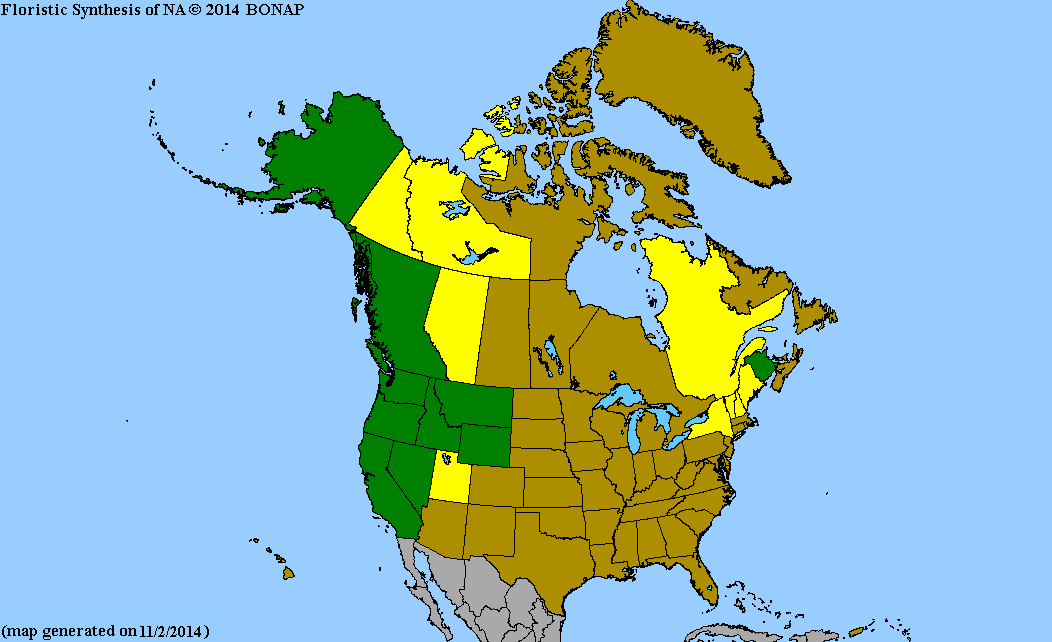
Arnica lanceolata is a North American species of flowering plant in the family Asteraceae, known by the common name clasping arnica[2] or lanceleaf arnica.[3] It has a disjunct (discontinuous) distribution in western North America and northeastern North America.[4][5]
| Arnica lanceolata | |
|---|---|
 | |
| Arnica lanceolata subsp. prima California | |
Scientific classification  | |
| Kingdom: | Plantae |
| Clade: | Tracheophytes |
| Clade: | Angiosperms |
| Clade: | Eudicots |
| Clade: | Asterids |
| Order: | Asterales |
| Family: | Asteraceae |
| Genus: | Arnica |
| Species: | A. lanceolata |
| Binomial name | |
| Arnica lanceolata Nutt. | |
| Synonyms[1][2] | |
| |
Arnica lanceolata is a perennial herb usually growing from a small rhizome and producing one or more hairy, glandular stems. The stems are lined with 5 to 10 pairs of oval-shaped, toothed leaves up to 12 centimeters long. The inflorescence is a cluster of several daisy-like flower heads with a center of brownish disc florets and a fringe of yellow ray florets 1 to 2 centimeters long. The fruit is a cylindrical achene covered in hairs and with a light brown pappus at one end.[2] It grows in moist areas, along stream banks, and montane to alpine meadows.[2]
- Arnica lanceolata subsp. lanceolata - Quebec, New Brunswick, Maine, New Hampshire, Vermont, New York
- Arnica lanceolata subsp. prima (Maguire) Strother & S.J.Wolf - Alaska, Yukon, Northwest Territories, Alberta, British Columbia, Washington, Oregon, California, Idaho, Montana, Utah, Wyoming, Nevada
References
- The Plant List Arnica lanceolata Nutt.
- "Arnica lanceolata subsp. prima in Flora of North America @ efloras.org". www.efloras.org. Retrieved 2022-05-14.
- USDA, NRCS (n.d.). "Arnica lanceolata". The PLANTS Database (plants.usda.gov). Greensboro, North Carolina: National Plant Data Team. Retrieved 26 May 2015.
- Biota of North America Program 2014 state-level distribution map
- "Arnica lanceolata ssp. prima Calflora". www.calflora.org.
External links
- Go Botany, New England Wildflower Society
- Maine Department of Agriculture, Conservation and Forestry, Maine Natural Areas Program, Arnica lanceolata Nutt., Flower of Hairy Arnica description and ecological information with photos
 | This Asteroideae article is a stub. You can help Wikipedia by expanding it. |
Другой контент может иметь иную лицензию. Перед использованием материалов сайта WikiSort.org внимательно изучите правила лицензирования конкретных элементов наполнения сайта.
WikiSort.org - проект по пересортировке и дополнению контента Википедии