bio.wikisort.org - Plant
Anubias gracilis is a plant that was first mentioned in 1920 by Chevalier and thereafter validly described by Hutchinson and Dalziel in 1936.[2]
| Anubias gracilis | |
|---|---|
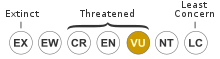
Conservation status | |
Scientific classification  | |
| Kingdom: | Plantae |
| Clade: | Tracheophytes |
| Clade: | Angiosperms |
| Clade: | Monocots |
| Order: | Alismatales |
| Family: | Araceae |
| Genus: | Anubias |
| Species: | A. gracilis |
| Binomial name | |
| Anubias gracilis Chev. ex Hutch. & Dalz. | |
Distribution
West Africa: Sierra Leone and Guinea.[2]
Description
Its long-stalked medium-green leaves are spade-shaped and may grow to 12 inches (30 cm) in length.[citation needed]
Cultivation
This plant grows best when only partially submersed and when not crowded by other plants. It requires a lot of nutrients, a loose, iron-rich substrate, and moderate-to-strong light. It prefers a temperature range of 22-26 degrees C (72-79 degrees F). It can be propagated by dividing the rhizome.[citation needed]
References
- "Anubias gracilis". IUCN Red List of Threatened Species.
- Crusio, W. (1979). "A revision of Anubias Schott (Araceae). (Primitiae Africanae XII)". Mededelingen Landbouwhogeschool Wageningen. 79 (14): 1–48.
Текст в блоке "Читать" взят с сайта "Википедия" и доступен по лицензии Creative Commons Attribution-ShareAlike; в отдельных случаях могут действовать дополнительные условия.
Другой контент может иметь иную лицензию. Перед использованием материалов сайта WikiSort.org внимательно изучите правила лицензирования конкретных элементов наполнения сайта.
Другой контент может иметь иную лицензию. Перед использованием материалов сайта WikiSort.org внимательно изучите правила лицензирования конкретных элементов наполнения сайта.
2019-2026
WikiSort.org - проект по пересортировке и дополнению контента Википедии
WikiSort.org - проект по пересортировке и дополнению контента Википедии