bio.wikisort.org - Plant
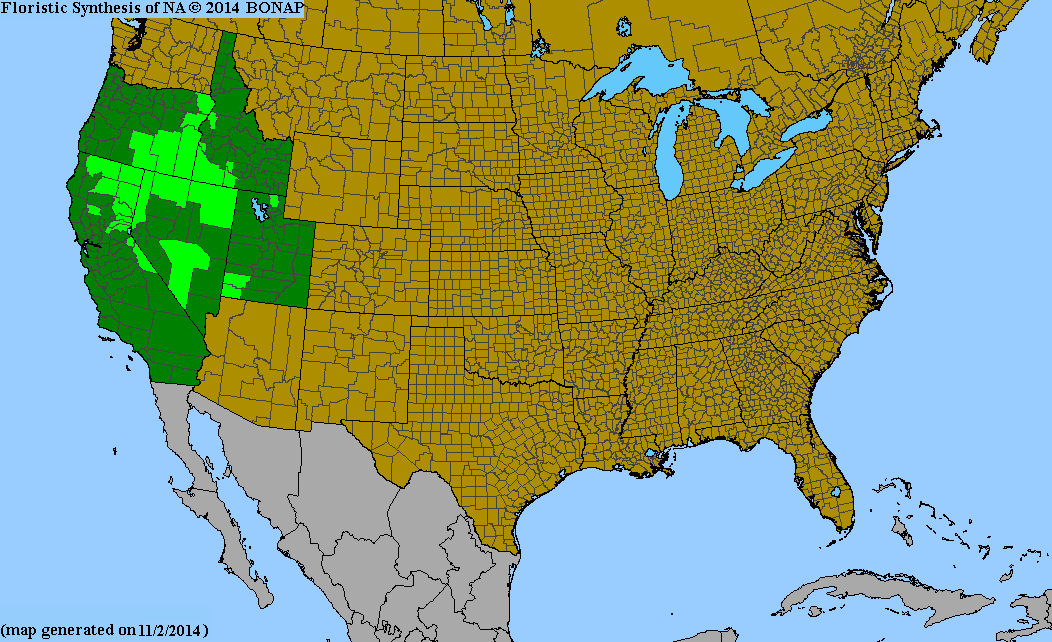
Allium lemmonii is a species of wild onion known by the common name Lemmon's onion, named for botanist John Gill Lemmon (1831–1908).[3] It is native to the western United States, at elevations of 1200–1900 m in the Great Basin of Utah, Nevada, northern and eastern California, eastern Oregon, southwestern Idaho.[4][5][6]
| Lemmon's onion | |
|---|---|
 | |
Scientific classification  | |
| Kingdom: | Plantae |
| Clade: | Tracheophytes |
| Clade: | Angiosperms |
| Clade: | Monocots |
| Order: | Asparagales |
| Family: | Amaryllidaceae |
| Subfamily: | Allioideae |
| Genus: | Allium |
| Species: | A. lemmonii |
| Binomial name | |
| Allium lemmonii | |
| Synonyms[1][2] | |
| |
Lemmon's onion grows from a bulb one and a half to two centimeters wide and has a short, flattened stem up to 20 cm tall, which is thin along the edges. Atop the stem is an inflorescence of 10 to 40 bell-shaped flowers, which may be white to pink. The stamens may be purple or yellow; pollen is yellow. The ovary has a distinctive ridged mound shape in which all of the ovary parts appear melded together. This is a common plant in its native range. It favors dry clay soils.[4][7][8][9]
References
- Tropicos
- The Plant List
- Watson, Sereno. 1879. Proceedings of the American Academy of Arts and Sciences 14: 234.
- USDA Plants Profile
- Flora of North America v 26 p 270, Allium lemmonii
- BONAP (Biota of North America Program) floristic synthesis, Allium lemmonii
- Jepson Manual Treatment
- Photo gallery
- Cronquist, A.J., A. H. Holmgren, N. H. Holmgren & Reveal. 1977. Vascular Plants of the Intermountain West, U.S.A. 6: 1–584. In A.J. Cronquist, A. H. Holmgren, N. H. Holmgren, J. L. Reveal & P. K. Holmgren (eds.) Intermountain Flora. Hafner Pub. Co., New York.
Другой контент может иметь иную лицензию. Перед использованием материалов сайта WikiSort.org внимательно изучите правила лицензирования конкретных элементов наполнения сайта.
WikiSort.org - проект по пересортировке и дополнению контента Википедии