bio.wikisort.org - Plant
Acacia aprica, or blunt wattle,[2] is a shrub belonging to the genus Acacia and the subgenus Juliflorae. It is native to the Wheatbelt region of Western Australia.[3]
| Blunt wattle | |
|---|---|
Conservation status | |
Scientific classification  | |
| Kingdom: | Plantae |
| Clade: | Tracheophytes |
| Clade: | Angiosperms |
| Clade: | Eudicots |
| Clade: | Rosids |
| Order: | Fabales |
| Family: | Fabaceae |
| Subfamily: | Caesalpinioideae |
| Clade: | Mimosoid clade |
| Genus: | Acacia |
| Species: | A. aprica |
| Binomial name | |
| Acacia aprica Maslin & A.R.Chapman | |
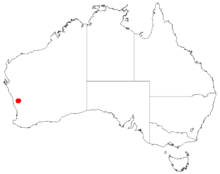 | |
| Occurrence data from AVH | |

Description
The diffuse spreading shrub can grow to a height of 0.3 to 2 metres (1 to 7 ft). It flowers from June to July producing yellow flowers. The plant will grown in red loam, sand or gravel soils and is often found on the plains or rocky hills.[3] Also known as Blunt Wattle.
Distribution
It grows in Beard’s Province: South-West Province, and in the IBRA regions: Avon Wheatbelt, Geraldton Sandplains.[3]
Endangered species
It is listed as critically endangered under the Wildlife Conservation Act of Western Australia,[4] and as endangered on the IUCN redlist.[2] and under the Commonwealth environmental protection act.[1]
It is mainly found on roadside verges and in small areas of remnant native vegetation within farmland, giving rise to the following threats:
- disturbance from road and firebreak maintenance;
- chemical drift from fertilisers and herbicides;
- competition from weeds; and
- inappropriate fire regimes[2]
See also
References
- Acacia aprica, Species Profile and Threats Database, Department of the Environment and Heritage, Australia.. Retrieved 16 November 2018.
- Williams, E. 2017. Acacia aprica. The IUCN Red List of Threatened Species 2017: e.T22483867A22484151. https://dx.doi.org/10.2305/IUCN.UK.2017-2.RLTS.T22483867A22484151.en. Retrieved 13 June 2018.
- "Acacia aprica". FloraBase. Western Australian Government Department of Biodiversity, Conservation and Attractions.
- Government Gazette(2018) Wildlife Conservation (Rare Flora) Notice 2017.Government Gazette, 16 January 2018, p.189 Retrieved 13 June 2018.
Другой контент может иметь иную лицензию. Перед использованием материалов сайта WikiSort.org внимательно изучите правила лицензирования конкретных элементов наполнения сайта.
WikiSort.org - проект по пересортировке и дополнению контента Википедии