bio.wikisort.org - Animal
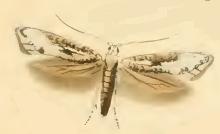
Prays oleae (olive moth) is a moth of the family Plutellidae found in Europe.
| Olive moth | |
|---|---|
 | |
Scientific classification  | |
| Kingdom: | Animalia |
| Phylum: | Arthropoda |
| Class: | Insecta |
| Order: | Lepidoptera |
| Family: | Praydidae |
| Genus: | Prays |
| Species: | P. oleae |
| Binomial name | |
| Prays oleae Bernard, 1788 | |
| Synonyms | |
| |
Description
The wingspan is 11–15 millimetres (3⁄8–5⁄8 in).
The larvae are a pest on olives (Olea europaea). Other recorded food plants include Phillyrea, jasmine and Ligustrum. They mine the leaves of their host plant which initially consists of an upper-surface, short, narrow corridor.[1]
Distribution
The moth is found in Southern Europe (the Mediterranean region) and North Africa. It was first found in Great Britain at a garden centre in Surrey in 2009 and has since been found at a light trap in Kent.[2]
Gallery
 Leafmines by Prays oleae larvae
 Larva
Larva Young larva
 Older larva
 Olive leaves mined by the young larva (2b, 2b*); olive shoot eaten by the mature larva (2b**)


References
- Ellis, W N. "Prays oleae (Bernard, 1788) small olive ermel". Plant Parasites of Europe. Retrieved 28 March 2020.
- Kimber, Ian. "22.004 BF449c Prays oleae (Bernard, 1788)". UKmoths. Retrieved 28 March 2020.
 | This article relating to the superfamily Yponomeutoidea is a stub. You can help Wikipedia by expanding it. |
На других языках
- [en] Prays oleae
[it] Prays oleae
La tignola dell'olivo (Prays oleae Bernard, 1788) è un lepidottero appartenente alla famiglia Praydidae. Specie fitofaga associata all'olivo, rappresenta una delle più importanti avversità di questa coltivazione.Текст в блоке "Читать" взят с сайта "Википедия" и доступен по лицензии Creative Commons Attribution-ShareAlike; в отдельных случаях могут действовать дополнительные условия.
Другой контент может иметь иную лицензию. Перед использованием материалов сайта WikiSort.org внимательно изучите правила лицензирования конкретных элементов наполнения сайта.
Другой контент может иметь иную лицензию. Перед использованием материалов сайта WikiSort.org внимательно изучите правила лицензирования конкретных элементов наполнения сайта.
2019-2026
WikiSort.org - проект по пересортировке и дополнению контента Википедии
WikiSort.org - проект по пересортировке и дополнению контента Википедии