bio.wikisort.org - Animal
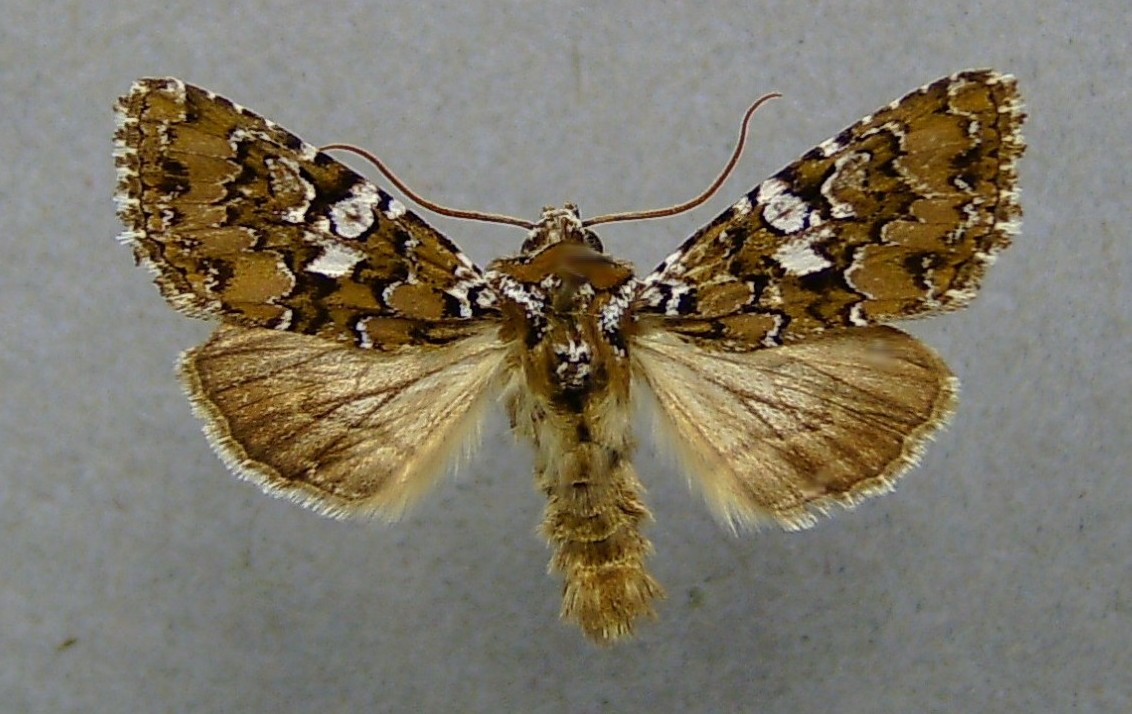
Eriopygodes imbecilla, the Silurian, is a moth of the family Noctuidae first described by Johan Christian Fabricius in 1794.[1][2]
| Eriopygodes imbecilla | |
|---|---|
 | |
| Scientific classification | |
| Kingdom: | Animalia |
| Phylum: | Arthropoda |
| Class: | Insecta |
| Order: | Lepidoptera |
| Family: | Noctuidae |
| Genus: | Eriopygodes |
| Species: | E. imbecilla |
| Binomial name | |
| Eriopygodes imbecilla (Fabricius, 1794) | |
| Synonyms | |
| |
Distribution
This species is present in most of Europe.[3][4]
Habitat
This species commonly lives on gullies and hollows in high moorland areas with host plants.[5]
Description
The wingspan is 24–27 mm.[6][7] The colour of these small moths may vary from tawny to reddish brown. Forewings usually show a pale kidney mark and two wavy cross lines, but often these markings are quite indistinct. Usually females are darker or chocolate brown and smaller than the males.[5] The rear wings are often pale greyish. Seitz describes it E. imbecilla F. (= aliena male Hbn., alpina female Hbn., disparilis O., nexa Dup.) Forewing rufous ochreous, sometimes grey-tinged, in the male, rufous brown in the female; veins finely brownish; inner and outer lines brown; submarginal obscure, the marginal area beyond it generally darker; reniform stigma externally whitish, preceded by a brownish median shade ; hindwing greyish fuscous : fringe rufous. — Larva dirty grey, with a few yellowish grey hairs; dorsal line fine, whitish, traversing a series of black or brown oval blotches : lateral stripes dark grey, with a pale line at middle ; spiracles black , each with a shining black point above it; head blackish, with 3 white lines.[8]
Biology
Adults fly from June to July.[5] Larvae are polyphagous on low plants, mainly feeding on bilberry (Vaccinium myrtillus), heath bedstraw (Galium saxatile),[5] Knautia and Lamium.[4][9]
References
- BioLib.cz
- Catalogue of Life
- Fauna Europaea
- Savela, Markku. "Lasionycta imbecilla (Fabricius, 1794)". Lepidoptera and Some Other Life Forms. Retrieved June 27, 2019.
- Butterfly Conservation
- "Eriopygodes imbecilla (Fabricius, 1794) - Silurian". The Cockayne Collection. Natural History Museum, London.
- The Moths of Suffolk
- Warren. W. in Seitz, A. Ed., 1914 Die Großschmetterlinge der Erde, Verlag Alfred Kernen, Stuttgart Band 3: Abt. 1, Die Großschmetterlinge des palaearktischen Faunengebietes, Die palaearktischen eulenartigen Nachtfalter, 1914
 This article incorporates text from this source, which is in the public domain.
 - Moths and Butterflies of Europe and North Africa

External links

 | This Hadeninae-related article is a stub. You can help Wikipedia by expanding it. |
Другой контент может иметь иную лицензию. Перед использованием материалов сайта WikiSort.org внимательно изучите правила лицензирования конкретных элементов наполнения сайта.
WikiSort.org - проект по пересортировке и дополнению контента Википедии