bio.wikisort.org - Animal
The black seabream (Spondyliosoma cantharus) is a species of Sparidae fishes. They are recognisable by their oval compressed body and jaws containing 4-6 rows of slender teeth which are larger at the front. They are silvery in colour with blue and pink tinges and broken longitudinal gold lines. They can reach a maximum size of 60 cm in length. They live in northern Europe and in the Mediterranean, usually found on the inshore shelf at depths varying from 5 to 300 m. They are usually found in schools feeding on seaweeds and invertebrates. They breed in February to May leaving eggs in the demersal zone.
| Black seabream | |
|---|---|
 | |
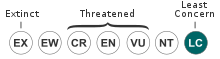
Conservation status | |
Scientific classification  | |
| Kingdom: | Animalia |
| Phylum: | Chordata |
| Class: | Actinopterygii |
| Order: | Perciformes |
| Family: | Sparidae |
| Genus: | Spondyliosoma |
| Species: | S. cantharus |
| Binomial name | |
| Spondyliosoma cantharus (Linnaeus, 1758) | |
 | |
| Range of black seabream | |
Black seabream are protogynous meaning females have the ability to change to males.
References
- Russell, B.; Pollard, D.; Carpenter, K.E. (2014). "Spondyliosoma cantharus". IUCN Red List of Threatened Species. 2014: e.T170258A1303321. doi:10.2305/IUCN.UK.2014-3.RLTS.T170258A1303321.en. Retrieved 11 November 2021.
External links
 Media related to Spondyliosoma cantharus at Wikimedia Commons
- Page at Fish Base (in English, German, French, and Italian)
 | This Perciformes article is a stub. You can help Wikipedia by expanding it. |
На других языках
- [en] Black seabream
[es] Spondyliosoma cantharus
La chopa (Spondyliosoma cantharus) (otros nombres: choupa, pañosa, pargo chopa) es un pez de la familia de los espáridos, común en la costa este del océano Atlántico y en el mar Mediterráneo.Другой контент может иметь иную лицензию. Перед использованием материалов сайта WikiSort.org внимательно изучите правила лицензирования конкретных элементов наполнения сайта.
WikiSort.org - проект по пересортировке и дополнению контента Википедии